Interactive Applications
laif foundation
Background
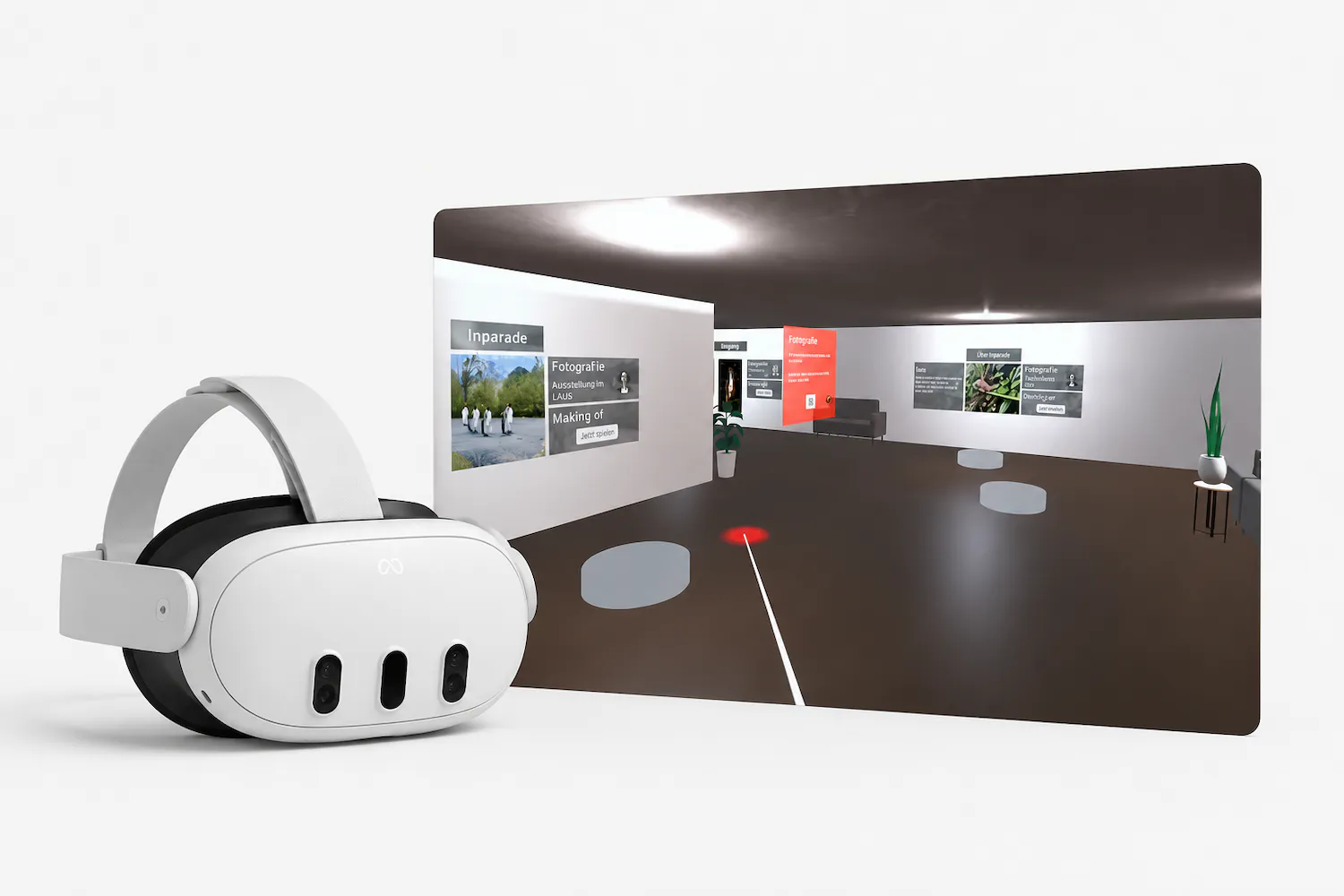
For this university project, the laif foundation commissioned us to explore how photojournalism could become more economically sustainable while also making its important role in democracy more visible. Our aim was to create an immersive experience that places users at the centre of the world of photojournalism. Rather than simply observing events, they would experience them up close and develop a deeper understanding of the work, responsibility and social value of photojournalists.
The project was developed within an interdisciplinary studio combining research, design and technology. Based on qualitative interviews and theoretical insights, we created a VR gallery that presents authentic photography in an immersive virtual space. We also developed a monetisation concept outlining new ways in which high-quality photojournalism could be funded sustainably over the long term.
Process
This project was my first experience developing for virtual reality. I took on the role of development lead and also contributed to the research and the production of the 360-degree videos. Overall, the project was an entirely new experience for me. Developing the VR application was surprisingly straightforward thanks to Unity’s extensive tutorials and documentation. Testing, however, was considerably more demanding because every new version first had to be transferred to the VR headset before it could be evaluated.
The development process was especially rewarding because our team worked together extremely well. Looking back, this was my favourite group project of the entire degree programme. One challenge was that we could not all work on the same project simultaneously. We therefore had to coordinate our push and pull requests carefully and communicate continuously to ensure that no work was lost through overlapping changes.
I also greatly enjoyed producing the 360-degree videos. It introduced me to a completely new approach to camera work, while also making the final result much harder to predict. Unlike with a conventional camera, you lose full control over the frame because the entire surrounding environment is recorded. I was responsible for filming the campfire video. In hindsight, the resulting videos were not only entertaining but also added unexpected value by further strengthening the immersive quality of the VR gallery.
Outcome