Interactive Applications
Planet Auszeit
Background
Because the University of Applied Sciences of the Grisons takes a strongly practice-oriented approach while the University of Fribourg focuses more on academic theory, one of the central requirements of the joint Master’s programme in Digital Communication and Creative Media Production was to combine the creative techniques we had learned with current research in the Master’s thesis. The aim was to develop a project with a practical use case in collaboration with an external partner.
As someone proud to call Baden home, I knew from the outset that I wanted to create a project for my hometown. I had long wanted to channel Baden’s cultural and industrial energy into creative work. To meet potential partners, I attended the launch event for Villa Langmatt’s book about its restoration. Full of enthusiasm but without a concrete plan, I approached several people working in culture and tourism in Baden. My vision, however, was already clear: I wanted to use augmented reality to make the city’s historical or cultural heritage accessible in an innovative and playful way.
My approach resonated with Andrea Portmann, Head of TourismusRegion Baden AG. She explained that topics such as resilience and mental health were currently a key focus and should be made more accessible to the public. This created the foundation for my Master’s thesis, and we agreed to collaborate.
Process
To develop the idea further, I first immersed myself in current research and specialist literature. I built a foundational understanding of mental health and mental well-being and examined evidence-based measures for promoting them. It quickly became clear that mindfulness is one of the key factors. I deliberately chose this focus because mindfulness has gained considerable attention through campaigns, apps and social media in recent years, while also being well supported by scientific research.
As my research progressed, I found that physical activity, social interaction and time spent in nature also support mental well-being. I also noticed that research on augmented reality and mental well-being frequently refers to Pokémon GO. Studies show that the game encourages people to be more active and engage in more social interaction.
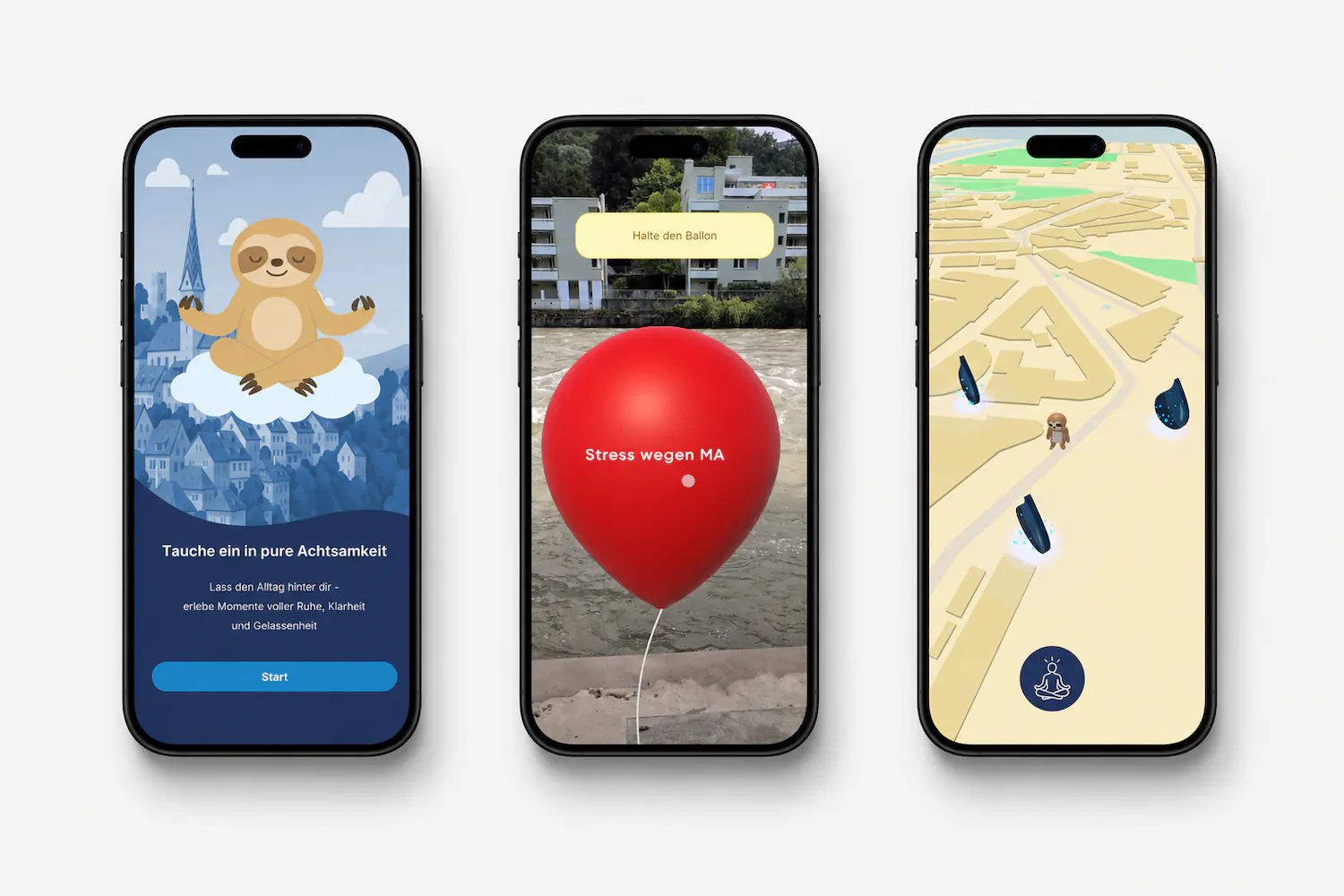
This gave me a clear direction. Niantic provided an interface that brought Pokémon GO’s location-based approach directly into Unity. It allowed me to place different “Health Spots” for mindfulness exercises throughout Baden. The locations were deliberately situated outdoors in restorative settings such as Kurpark, the Limmat promenade and Stein Castle ruins.
Selecting the exercises was challenging. They needed to be scientifically grounded while also being feasible within the technical possibilities of Unity and augmented reality. I drew on established exercises and reviewed the research literature to assess their effectiveness. This resulted in three exercises: affirmations, a breathing exercise and letting go of thoughts. I also developed a location-independent meditation exercise so that the application could be used more flexibly.
For the visual design, I looked to successful apps such as Headspace, Pokémon GO and Duolingo. Their colour palettes, user interfaces, sound effects and playful design approaches served as inspiration. I created a sloth as the user’s companion, whose calm personality represented the theme of mindfulness and guided users through the city of Baden.
Once the prototype was complete, it was evaluated through usability testing followed by interviews. The feedback was largely positive. Participants particularly appreciated the sloth, the combination of movement, nature and mindfulness, and the innovative use of augmented reality. They also raised some critical points. Several participants found the smartphone distracting and preferred mindfulness exercises without digital support, while others considered some of the sound effects disruptive.
Outcome
The project was completed successfully and received the highest possible grade of 6.
I would like to take this opportunity to thank my project partner once again for the straightforward collaboration and valuable support.
